Mystery Worshipper: Amanda B. Reckondwyth
Church:
St Stephen Byzantine Catholic Cathedral, Phoenix
Location: Arizona, USA
Date of visit: Friday, 29 May 2026, 10:00am
The building
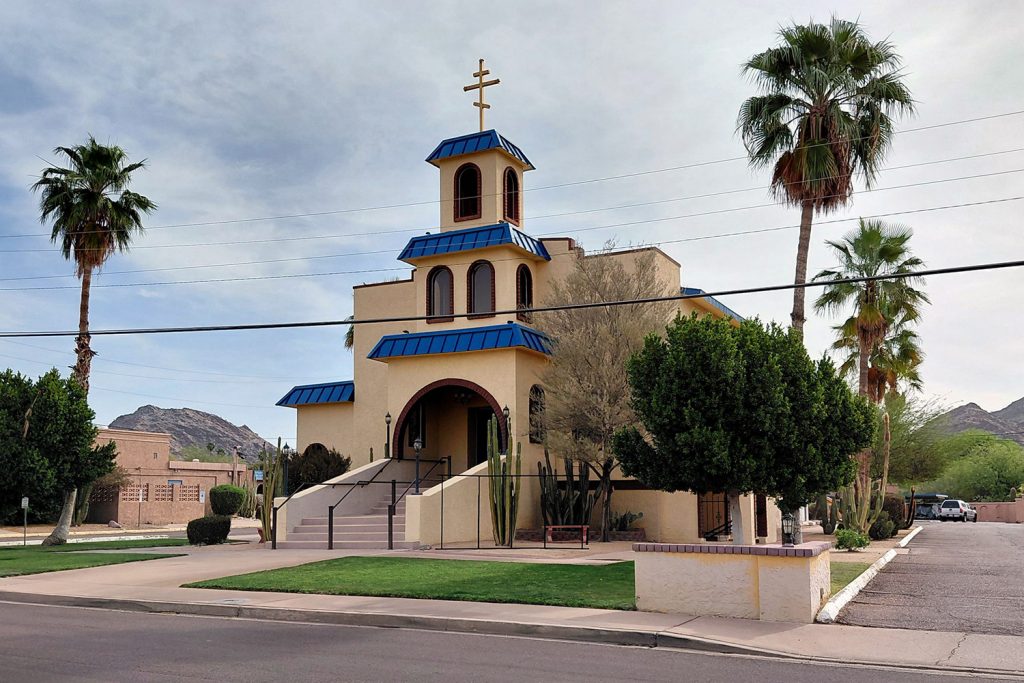
Formerly an Antiochian Orthodox church, the building was acquired by Byzantine Catholics in 1968 and elevated to cathedral status in 2010. The stucco exterior features Byzantine architectural elements such as onion domes and arched facades, along with decorative crosses and a prominent central dome. The nave and sanctuary are divided by the customary iconostasis, which features tiered rows of icons depicting Christ, the Theotokos, and major saints. A table on which rests the icon of the day stands in front of the iconostasis. The bishop's cathedra is positioned prominently in the sanctuary to the side of the altar. The walls are adorned with icons in the Eastern Christian style.
The church
The cathedral maintains an active program of religious education and faith formation, and extends a special welcome to all Christians of other denominations, as well as Roman Catholics who are drawn to the traditions of the Eastern Church. Terce and Sext are said each weekday except Mondays, with the Divine Liturgy celebrated on Saturdays and Sundays.
The neighborhood
The cathedral is situated on 16th Street at Northern Avenue. Nearby is the Dreamy Draw Recreation Area, noted for its hiking and biking trails. Mercury sulfide was mined in the area in years gone by, and ‘dreamy draw’ was the term used to describe the dazed, drunken-like state suffered by miners exposed to hazardous mercury vapors. Most of the mines were paved over when State Route 51, a major north-south highway, was constructed. Even so, some still exist, although they are said to be depleted of mercury. Piestewa Peak, the second highest mountain within the Phoenix city limits, is a prominent feature of the area. The mountain was named in honor of US Army soldier Lori Ann Piestewa, the first known Native American woman to die in military combat.
The cast
No one was identified by name or title, but judging from their website photos I’m pretty sure it was the Bishop Emeritus of the Eparchy of Phoenix who celebrated, as the website states that the sitting bishop was visiting another parish today. The bishop emeritus was assisted by the rector and deacons of the cathedral. There was a choir consisting of three cantors. A layman chanted the epistle.
What was the name of the service?
Palm Sunday: Divine Liturgy (Festal Tone).How full was the building?
I counted room for about 100 and it was completely full, with standees in the rear. A mixed crowd of all ages, but I’d say it favored the young.
Did anyone welcome you personally?
A woman came up to me and asked, ‘Have you been here before?’ When I answered no, she continued, ‘But are you familiar with the Byzantine liturgy?’ She made sure that I had taken a bulletin and a hymn sheet, and also opened a drawer to reveal a stack of booklets entitled The Divine Liturgy of Our Holy Father John Chrysostom.
Was your pew comfortable?
Rather narrow and severe, but not really uncomfortable. When I grabbed hold of the pew in front of me to steady myself while standing, I discovered that it was not fastened to the floor. I hoped I had not thrown the people occupying it off balance when they went to sit again (I appear not to have).
How would you describe the pre-service atmosphere?
People entered quietly as the cantors were chanting the office of Terce. As people entered, they venerated the icon of the day by bowing, crossing themselves, and kissing it. The clergy were puttering about the sanctuary – I couldn’t tell if they were taking part in Terce or merely visiting with one another. A priest off to the side was hearing confessions. Penitents approached him one at a time and sat by his side while they whispered their transgressions in his ear. As he gave each one absolution, he covered their heads with his stole and made the sign of the cross on it.
What were the exact opening words of the service?
For the blessing of the palms we sang a hymn that began: ‘The people in great throngs had gathered to greet our Lord in Jerusalem.’ The service proper began with the deacon chanting: ‘Reverend Father, give the blessing,’ to which the celebrant replied: ‘Blessed is the kingdom of the Father, and of the Son, and of the Holy Spirit, now and forever.’
What books did the congregation use during the service?
There was a bulletin that contained the day’s epistle and gospel readings as well as announcements. There was also a hymn sheet. I also had the Divine Liturgy booklet that the helpful lady gave me from the drawer. However, I was apparently the only person who took one of those booklets.
What musical instruments were played?
None. All singing was a cappella. Led by the three cantors, the people seemed to know all the chants and hymns and sang along lustily.
Did anything distract you?
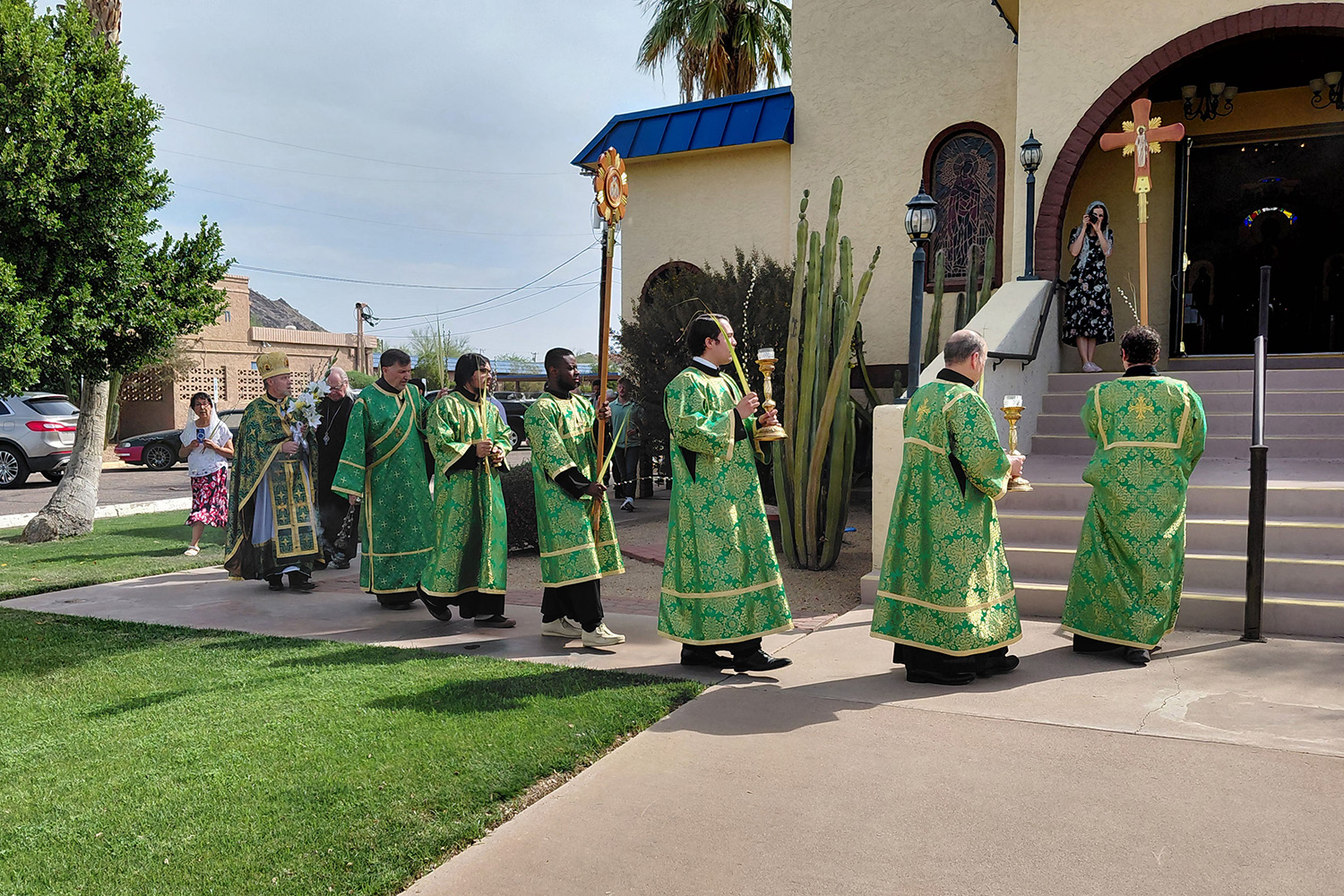
Trying to figure out who was who, and what was going on when, was distraction enough. The Divine Liturgy booklet was extremely helpful, but the service did not follow it 100 per cent. The clergy all wore green vestments – was I wrong to expect red on Palm Sunday? But then again, ‘When in Constantinople, do as the…’ and all that.
Was the worship stiff-upper-lip, happy clappy, or what?
You can’t get much more stiff upper lip than the Divine Liturgy of St John Chrysostom. The entire service was chanted in English. We began with the blessing and distribution of palms – we were given a palm frond plus a swig of pussy willow, and we all processed outside the church, circling it once. The liturgy itself included all of the elements those familiar with the Divine Liturgy of St John Chrysostom would recognize and expect. As mentioned, it was all in English and entirely chanted, with incense galore. The people seemed thoroughly familiar with it all.
Exactly how long was the sermon?
13 minutes.
On a scale of 1-10, how good was the preacher?
10 — I’m flipping all of the cards for the bishop emeritus (if that’s who it was). He stepped out into the congregation to preach, and did not use notes. He spoke clearly and animatedly and made good rapport with the congregation.
In a nutshell, what was the sermon about?
The bishop emeritus spoke on the gospel reading for the day: John 12:1-18 (Mary and Martha serve Jesus a meal with Lazarus present, and Jesus enters Jerusalem the next day). When Jesus raised Lazarus from the dead, it was ‘a shot heard round the world.’ Yes, resurrections had been performed before, but on people who had been dead for minutes or hours, not for four days as Lazarus had been. Before Jesus raised Lazarus, he asked Martha if she believed. Do we believe? Jesus allowed himself to be glorified by the people as he entered Jerusalem, knowing full well what those same people would do five days later. But his true glory came on the cross, when he conquered death and established a new kingdom. This shows how God works – through humility, not through glory. Jesus was humble right from the moment of his birth. Let humility be our virtue.
Which part of the service was like being in heaven?
The fact that it was all in English and eminently understandable. I am not a fan of Byzantine liturgy in Greek, Slavonic, or other languages I don’t understand and can’t follow along.
And which part was like being in... er... the other place?
I will not comment on the footwear of some of the altar party except to say it was not black leather.
What happened when you hung around after the service looking lost?
I confess that I left at communion. Interestingly, though, the liturgy booklet included a paragraph stating that communion was open to all Catholics ‘as well as members of certain other churches that profess the Real Presence of Jesus Christ in the Eucharist.’ This, in a church that is in communion with Rome! Also included was a short description of how to receive communion on a spoon, but I did not trust myself not to make a mess of it.
How would you describe the after-service coffee?
I saw no indication that any would be on offer.
How would you feel about making another visit (where 10 = ecstatic, 0 = terminal)?
5 — My rating says nothing about the service itself, which was beautiful and moving, especially as it was all in English. My rating merely refers to my likelihood of returning for another visit. This is not my neighborhood, but I may return on another special occasion and even attempt to receive communion on a spoon!
Did the service make you feel glad to be a Christian?
Yes.
What one thing will you remember about all this in seven days' time ?
Communion being open to all who profess the real presence.